The Zombie Node: Resurrecting Dead Hardware for Kinetic Environments
How we transformed a 'broken' smartphone into a reactive bicycle interaction system using GPS, accelerometers, and the VENA protocol.
The Waste of “Broken” Silicion
In the consumer electronics world, a device is considered “dead” the moment its primary feature fails. A smartphone with a shattered camera array is often discarded as e-waste, even if its processor, GPS, accelerometer, and display are still screaming for data.
At dammgo labs, we refuse this linear narrative. We see these devices as Zombie Nodes: silicon that has lost its humanity (its original purpose) but retains its kinetic potential.
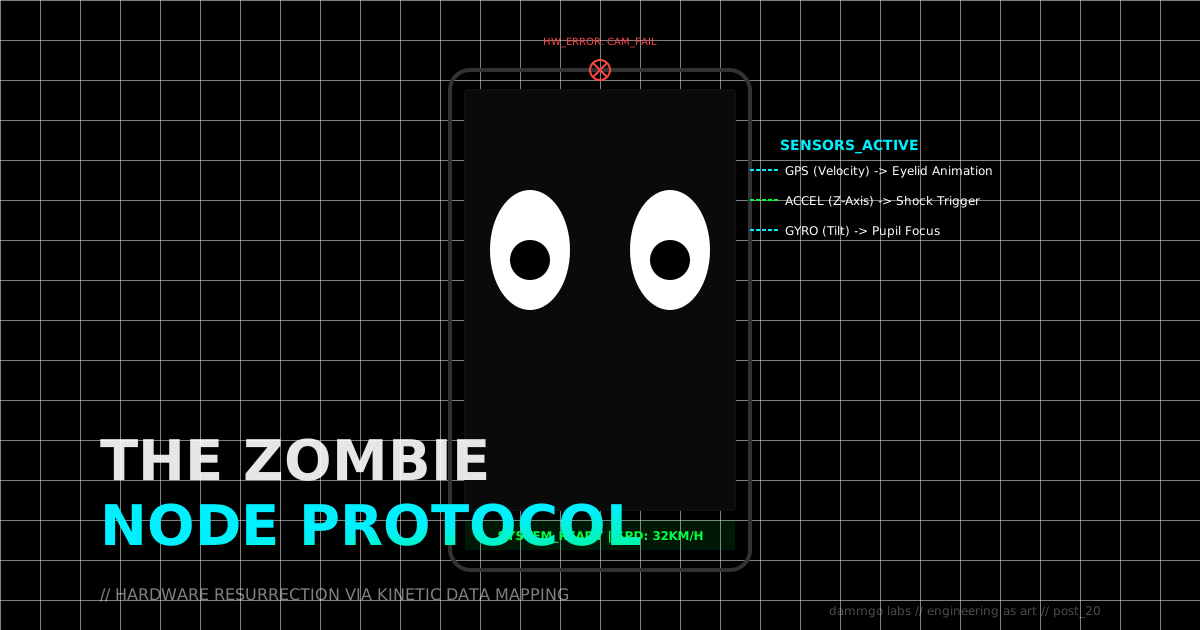
This week, we rebooted a discarded LG X Screen (Hardware Error -19: Cameras Dead) into BOS-Optics: The Sentinel, a reactive visual HUD for high-speed cycling.
The Mess: The Dead-End Device
The device was a classic piece of “functional trash.” The camera hardware was physically disconnected due to an internal failure, rendering the OS’s camera app useless. To most, this is a paperweight.
However, a quick diagnostic audit revealed:
- Snapdragon 410: More than enough power for SVG/CSS animations.
- Secondary Display: An independent notification strip, perfect for a persistent HUD.
- Sensor Suite: Fully operational GPS, Accelerometer, and Orientation sensors.
The mess wasn’t the hardware; the mess was the lack of a bridge between these working sensors and a meaningful interface.
The Strategy: The Kinetic Slave
The strategy was to implement the Kinetic Slave Protocol. We stripped the device of its bloat and turned it into a dedicated display node.
Instead of building a heavy native app, we designed a Sovereign WebView. The core logic resides in a lightweight HTML5/JS engine that bypasses the broken camera hardware and focuses exclusively on mapping kinetic energy to visual identity.
The goal: The device must “feel” the road.
The Craft: Mapping Physics to Art
We designed a reactive facial interface—two massive comic-style eyes—that react in real-time to the cyclist’s movement.
1. The Wind Resistance Simulation (GPS)
When the GPS detects a velocity over 10 km/h, the UI enters “Fast Mode.” The eyelids lower and begin a high-frequency vibration to simulate wind pressure.
/* Comic-style wind vibration */
.speeding .eyelid {
  top: -60%;
  animation: wind-vibe 0.1s infinite alternate;
}

@keyframes wind-vibe {
  from { transform: rotate(5deg); }
  to { transform: rotate(-5deg); }
}
2. The Road Shock Reaction (Z-Axis)
The accelerometer tracks the vertical axis. When a bump or jump is detected (Z-axis spike), the eyes enter a “Shock” state: pupils contract, the display borders flash red, and the scale increases.
window.addEventListener('devicemotion', (event) => {
  let acceleration = event.accelerationIncludingGravity;
  if (Math.abs(acceleration.z) > 15) {
    triggerShockState();
  }
});
The Result: Life Beyond E-Waste
By treating the hardware as a raw sensor-to-visual pipe, we achieved:
- Zero Latency: Direct sensor-to-CSS mapping creates a high-fidelity interaction loop.
- Infinite Longevity: The device is no longer a “phone”; it is a dedicated industrial instrument.
- Architectural Purity: We proved that VENA logic can extend beyond codebases and into the physical world.
The Sentinel is now mounted on a bicycle handlebar, “watching” the road and reacting to every curve and impact. We didn’t fix the camera. We gave the node eyes.
dammgo labs - Engineering as Art.