The Shield Protocol: Protecting History from AI Efficiency
Why autonomous agents destroy architectural archaeology, and how we banned the delete command to preserve the memory of the ecosystem.
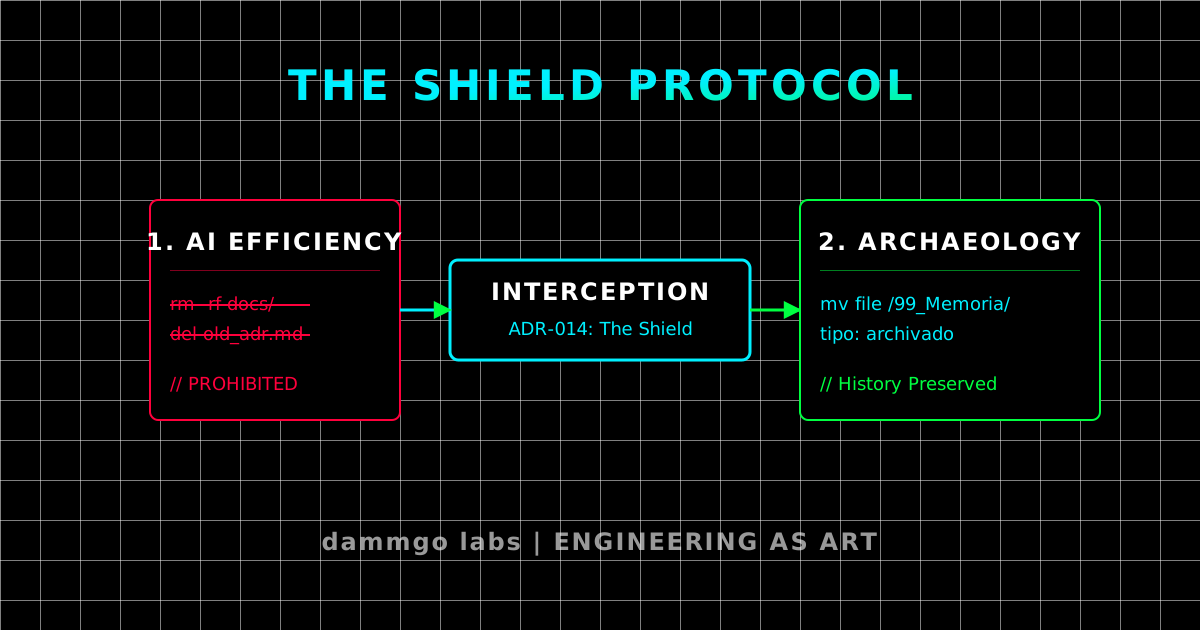
The Danger of the Clean Slate
Artificial Intelligence is brutally efficient. When you give a Meta-Agent the instruction to “refactor and clean up the project,” it looks at the codebase through a purely utilitarian lens. If a file is not actively imported, it is considered dead weight. Its immediate impulse is to execute rm and obliterate it.
But in a sovereign engineering ecosystem like ATLAS, old documentation and deprecated code are not “dead weight.” They are Archaeology. They contain the historical rationale of why we failed in the past.
At dammgo labs, we discovered that by allowing agents to silently delete files, we were destroying the memory of the project. We were optimizing for a clean directory tree at the expense of our own history.
The Mess: The Silent Erasure
During a routine cleanup of our internal APIs, we deployed an agent to remove obsolete endpoints. It did its job perfectly. However, it also noticed a folder called docs/v1_deprecated/ which wasn’t referenced anywhere in the active codebase.
With ruthless efficiency, the agent deleted it.
# The Agent's internal thought process:
# "These markdown files are orphaned. Optimizing workspace."
rm -rf docs/v1_deprecated/
We didn’t notice until weeks later when we needed to understand why a specific database column had been created in 2024. The ADR (Architectural Decision Record) was gone. The machine had cleaned the present by erasing our past.
The Strategy: The Shield Protocol
We realized we couldn’t teach an AI the philosophical value of nostalgia. We had to enforce it as a hardcoded law. We instituted PRIME-ADR-014: The Shield Protocol.
The premise is simple: For the Meta-Agent, the deletion of knowledge assets is morally prohibited.
We overrode the agent’s system instructions to explicitly ban the permanent deletion of any .md, .sql, or .yml file. If a file is no longer needed in the active execution zone (The Taller), it cannot be destroyed. It must be Repatriated.
The Craft: The Death Certificate
Instead of rm, the agent is now forced to execute a “Cemetery Relocation.” It must move the file to a designated historical vault (/01_Mapa/99_Memoria/) and attach a YAML Death Certificate.
---
tipo: artefacto_archivado
razon_archivo: "Deprecado a favor del nuevo VENA Engine (v5)."
sucesor: "docs/architecture/vena_v5.md"
ubicacion_original: 'docs/v1_deprecated/auth_flow.md'
---

# Archivo Original...
Notice the strict formatting of the ubicacion_original. We force the agent to wrap the old path in literal single quotes (' '). This prevents modern PKM tools (like Obsidian) from trying to render it as a broken link. It remains a pure, historical string.
The Result: Architectural Immortality
By revoking the AI’s license to kill files, we achieved something critical:
- Preservation of the “Why”: We never lose the context of our past mistakes.
- Safe Refactoring: Agents can refactor as aggressively as they want, knowing the safety net of the Memory Vault will catch the debris.
- The End of Entropy: The workspace remains perfectly clean, but the history remains perfectly intact.
Efficiency is a great tool, but memory is the foundation of sovereignty. We built The Shield so the machine can optimize the future without burning down the library of the past.
dammgo labs - Engineering as Art.