The Immutable Trace: Beating AI Amnesia
Why architectural decisions must survive the chat window. Implementing ADRs and Session Traces as the true anchor of sovereign engineering.
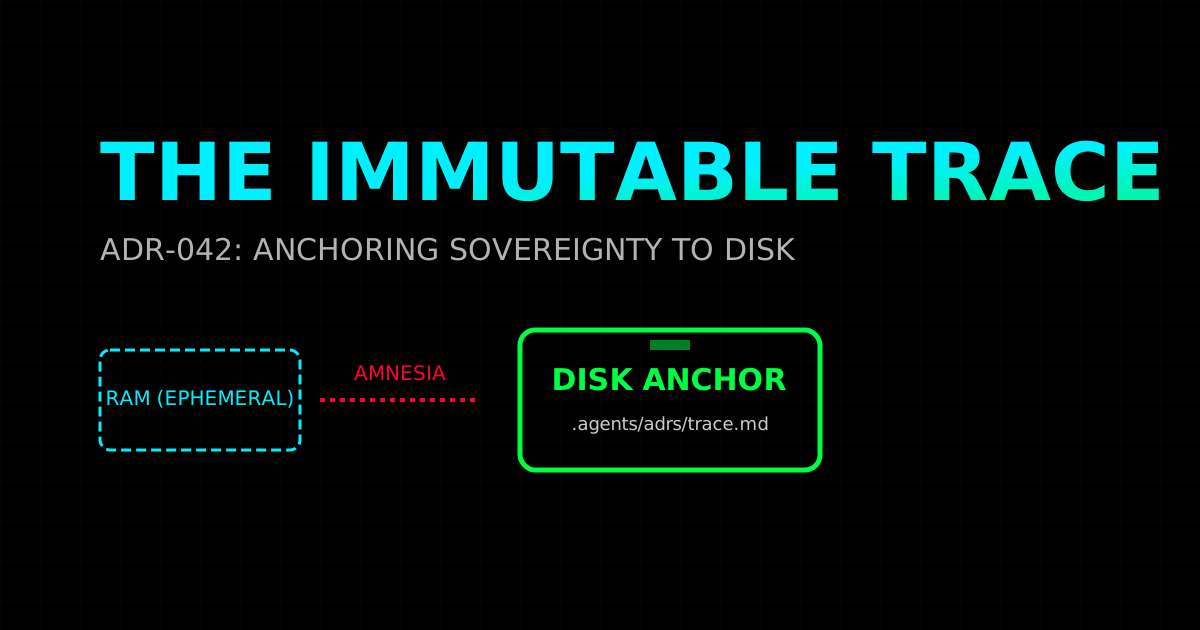
The Ephemeral Chat Trap
In the era of Agentic AI, the interface is seductive. We converse with systems, design complex architectures in a single thread, and iterate at lightspeed. But this conversational paradigm hides a fatal flaw: Amnesia.
When the context window clears, the architectural intent vanishes. What remains is only the final code—a silent artifact with no historical memory of the why. If a system’s intent lives only in the ephemeral memory of an AI chat session, the project is not sovereign; it is constantly on the verge of dementia.
At dammgo labs, we discovered that longevity cannot rely on the AI’s ability to “remember.” It must be enforced by the environment. This week, we implemented The Immutable Trace: a strict protocol where every architectural bifurcation is anchored to the hard drive via Architectural Decision Records (ADRs) and Session Traces.
The Mess: The Silent Refactors
Before the Immutable Trace, our agentic workflows suffered from “silent refactors.” An agent would optimize a module, drastically changing the structure, but the reasoning was buried in a discarded chat session.
// A week later, another agent encounters this:
export function executeKineticBridge(payload) {
  // Why was the legacy bridge bypassed here?
  // The context was lost in Chat Session #802.
  if (payload.entropy > 0.8) return fallback();
  return runVenaCore(payload);
}
When a new agent was spawned to fix a bug, it had no context. It would inevitably attempt to rewrite the executeKineticBridge, breaking the delicate logic that a previous agent had engineered. This is the definition of high entropy.
The Strategy: The Disk as the Sovereign Anchor
The strategy was brutal but necessary: No architectural decision is valid unless it is written to disk.
We created a VENA protocol mandate that forces the Meta-Agent to step out of the chat window and generate an ADR (Architectural Decision Record) or a Session Trace before executing any code changes that alter the project’s course. The hard drive is the only trusted source of truth.
If it’s not in the .agents/skills or .agents/adrs directory, it never happened.
The Craft: Forcing the Write
We integrated a verification step in our agentic loop. When the Meta-Agent detects a structural change, it halts execution and delegates the documentation to a specialized sub-identity (like atlas-scribe).
# ADR-042: Kinetic Bridge Entropy Threshold
**Date:** 2026-06-26
**Context:** High entropy payloads were crashing the legacy bridge.
**Decision:** Bypass legacy bridge if payload.entropy > 0.8 and route directly to VENA Core.
**Consequences:** Requires VENA Core to handle unfiltered raw data, but guarantees zero-latency fallbacks.
The agent then uses this local, immutable file as its primary context. The chat memory becomes irrelevant.
The Result: True Sovereign Architecture
By anchoring decisions to the file system, we achieved:
- Context Resilience: Any agent can be destroyed and respawned without losing the architectural narrative.
- Deterministic Debugging: We know exactly why a piece of code exists.
- The End of AI Amnesia: The ecosystem is immune to context-window limitations.
We didn’t just improve our documentation. We engineered a system where the machine cannot be anything other than rigorous. The code is the output, but the Immutable Trace is the soul.
dammgo labs - Engineering as Art.