The Ghost in the Worktree: Modernity in Legacy Soils
How we fixed a broken 2026 deployment workflow on a 2013 legacy server by understanding the anatomy of Git pointers.
The Ghost in the Worktree: Modernity in Legacy Soils
“Engineering is not about the tools you use, but about how well you understand the bits they move.”
1. The Mess (The Diagnostic)
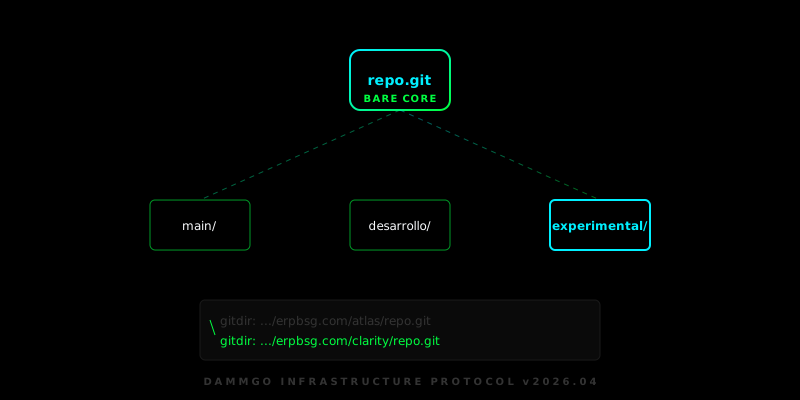
Yesterday, a routine rebranding from Atlas to Clarity triggered a silent crisis in our deployment pipeline. Our setup was designed for 2026 efficiency: a local repository pushing to GitHub, triggering a webhook to a shared Linux server where we use Git Worktrees to manage main, desarrollo, and experimental branches in isolated directories.
Then, the ghost appeared.
We pushed a hotfix to the experimental branch, but instead of updating its own directory, it overwrote the main production site. The diagnostic revealed a collision of eras: we were operating a modern multi-branch architecture on a server running Git 1.8.3.1—a version released in 2013, two years before the git worktree command even existed.
The rename of the root folder from /atlas/ to /clarity/ had decapitated the pointers. Since the native worktree commands were missing, the environment was blindly falling back to the repository root, mixing branch contents and threatening the integrity of the entire ecosystem.
2. The Strategy (The Vision)
The easy way out is always the same: blame the hosting provider, upgrade the server, or start from scratch.
The dammgo labs way is different. We choose to understand the bit.
A Git Worktree is not a high-level magic trick; it’s just a set of text files pointing to each other. Even if the Git binary is a decade old, it still obeys the file system logic. Our strategy was to perform a manual link restoration: bypassing the command line and repairing the internal gitdir files and the hidden metadata inside the bare repository to restore context awareness to the legacy environment.
3. The Craft (The Transformation)
We performed surgery on the anatomy of the repository. No high-level abstractions, just fundamental precision.
Step 1: Repairing the Worktree Pointers
Inside each worktree folder, the .git file is not a directory, but a single line of text. It was pointing to a ghost path. We forcibly re-programmed it via SSH:
# Re-linking the worktree folder to the central bare repository
echo 'gitdir: /home/user/hosting/erpbsg.com/clarity/repo.git/worktrees/experimental' > ./experimental/.git
Step 2: Repairing the Bare Repository Registry
The bare repository keeps its own record of where its worktrees live. We synchronized the reality in the repo.git/worktrees/[branch]/gitdir pointers:
# Re-linking the central registry to the physical folder
echo '/home/user/hosting/erpbsg.com/clarity/experimental/.git' > ./repo.git/worktrees/experimental/gitdir
4. The Result (The Art)
By understanding the underlying data structure, we transformed a “broken server” into a predictable environment without changing a single line of the provider’s configuration.
- Zero Downtime: Production remained stable while we performed surgery on the
experimentallink. - Legacy Resilience: Our modern workflow now runs perfectly on a 13-year-old Git version.
- Engineering Sovereignty: We proved that when you know how the engine works, you are no longer a prisoner of the dashboard.
Metrics of the Reboot:
- Status: Stabilized.
- Complexity: Manual path resolution replaced by deterministic precision.
- Lesson Learned: Tools change, but pointers are forever.
dammgo labs - Engineering Longevity. Clarity as Law.