The Boundary Contract: Killing the Suicidal Coupling
How we implemented Sovereign DTOs to stop raw backend structures from poisoning our UI and causing silent production failures.
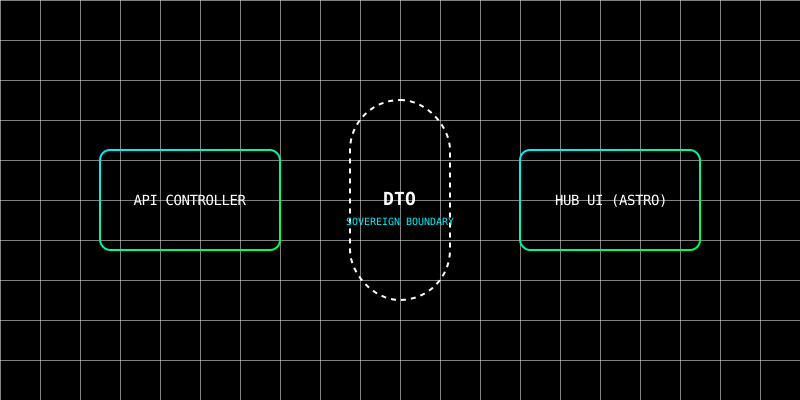
The Fragility of Trust
In the early days of a project, trust is a feature. You trust that your API will return the fields your frontend expects. You trust that a category will always be a string. You trust that the amount will always be a float. This trust allows for rapid prototyping and “vibe coding” speed.
But as a system matures into a Sovereign Core, trust becomes a liability. In a large-scale ecosystem like ATLAS, trusting an unvalidated array flowing from the database to the users screen is a form of architectural suicide.
The Mess: The “Array of Doom”
In our legacy Treasury module, we were suffering from what I call Leakage of Implementation. Our controllers were taking raw Domain Entities and flattening them into associative arrays on the fly. Look at this snippet from our TreasuryController:
// The Suicidal Controller
public function getTransactions($branchId, array $filters = []): void
{
    $data = $this->transactionRepo->findRecent($branchId, 50, $filters);
    $this->jsonResponse(array_map(fn($t) => [
        'id' => $t->getId(),
        'amount' => $t->getAmount(),
        'type' => $t->getType(),
        'category' => $t->getCategory()->getName(),
        'date' => $t->getDate()->format('Y-m-d H:i:s')
    ], $data));
}
On the surface, it looks clean. But the UI (The Hub) is now a hostage to this specific array structure. If a developer renames amount to value in the database, the backend might still pass its tests, but the UI will silently go blank. The “contract” was written in sand.
The Strategy: Sovereign Boundaries
The reboot strategy was simple but non-negotiable: Total Decoupling through Data Transfer Objects (DTOs).
We decided that no raw data should ever cross the boundary between the Application Layer and the Infrastructure Layer (The API) without being transformed into a dedicated Response Contract.
We introduced three rules:
- No Anonymous Arrays: Every API response must be a typed object.
- One-Way Mapping: The Domain knows nothing about the API; the API knows how to transform the Domain.
- Immutability: Once a DTO is created, it cannot be changed. It is a snapshot of truth.
The Craft: The Transformer Pattern
We implemented a Sovereign Transformer for our Treasury movements. Instead of manual array_map calls, we now use a dedicated engine that enforces the contract.
// The New Sovereign Way
public function getTransactions(int $branchId): void
{
    $transactions = $this->queryBus->ask(new GetRecentMovements($branchId));

    // The Transformer enforces the "Boundary Contract"
    $response = TransactionResponseTransformer::collect($transactions);

    $this->jsonResponse($response);
}
And the DTO itself acts as the Guardian of the Schema:
readonly class TransactionResponseDTO {
    public function __construct(
        public int $id,
        public float $amount,
        public string $typeLabel,
        public string $categoryName,
        public string $categoryIcon,
        public string $formattedDate,
    ) {}
}
By doing this, we moved the formatting logic (like $date->format()) out of the controller and into the Transformer. The UI no longer cares about how the date is stored; it only cares about the formattedDate string it receives.
The Result: Architectural Peace
By killing the “Suicidal Coupling,” we achieved Cognitive Sovereignty.
- Frontend Stability: Our Hub developers can now rely on a fixed contract. They don’t need to read PHP code to know what the API returns; they read the DTO.
- Backend Freedom: We can refactor our database schema or our internal Domain logic with zero fear of breaking the UI, as long as we update the Transformer to satisfy the DTO.
- Silent Failure Prevention: If a field is missing or the wrong type, the system fails at the Transformer level (with a clear error) rather than failing at the UI level (with a “null” that breaks a React component).
In the VENA Protocol, the boundary is not a wall; it is a filter. And only the truth gets through.
dammgo labs - Engineering as Art.