Sovereign Trust: The Local Certificate Authority
How we eliminated SSL warnings and env parity friction by building our own Root CA for the erpbsg ecosystem.
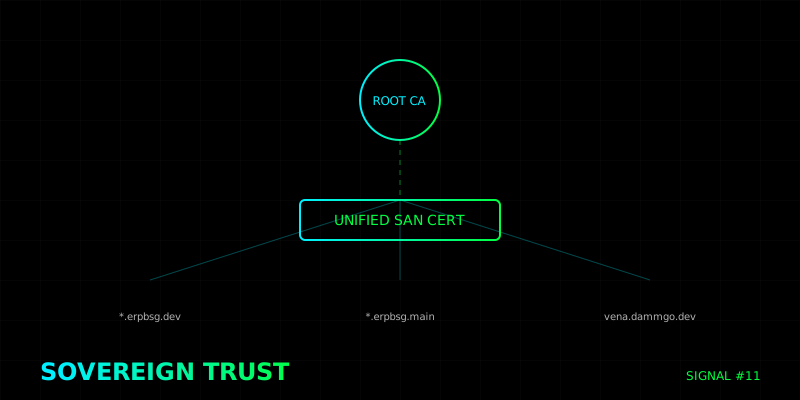
The Obsession with Infrastructure Parity
In a world of microservices and local development, the “Your connection is not private” screen is more than an annoyance; it’s a signal of broken parity. If your local environment doesn’t reflect the security constraints of production, you aren’t building high-fidelity software—you are building a simulation that will fail when it meets reality.
At dammgo labs, we don’t bypass security. We own the authority.
The Mess: The “Ignore” Culture
For years, the standard approach to local development was a mess of self-signed certificates or, worse, running everything on raw HTTP while hoping localhost would handle the CORS and Cookie-Secure headers correctly.
The chaos looked like this:
- Domain Mismatch:
api.erpbsg.devrequiring different certs thanapp.erpbsg.dev. - Browser Friction: Clicking “Advanced -> Proceed” every 30 minutes.
- Mobile Debugging: Impossible to test HTTPS-only features on physical devices without a complex proxy setup.
We were outsourcing our trust to “defaults” that didn’t scale with our sovereignty.
The Strategy: Becoming the Authority
The strategy was simple but radical: Stop asking for permission; become the source of trust.
By using mkcert, we created a local Certificate Authority (CA) that we installed across our entire fleet (MateBook-14, Ideapad, and mobile devices). This allowed us to issue a Unified SAN (Subject Alternative Name) Certificate that covers our entire namespace.
One certificate. One key. Total trust.
The Craft: The Unified Command
The beauty of this reboot lies in its determinism. Instead of managing 20 different .pem files, we consolidated our entire local infrastructure into a single command that issues a sovereign pass for everything from our legacy hubs to our AI engines.
# The Sovereign Command (v2026.04)
mkcert -cert-file atlas-unified.pem -key-file atlas-unified-key.pem `
  api.erpbsg.dev app.erpbsg.dev atlas.erpbsg.dev clarity.erpbsg.dev `
  connect.erpbsg.dev mi.erpbsg.dev website.erpbsg.dev `
  legado.erpbsg.main legado.erpbsg.stable-dev `
  vena.dammgo.dev
This single atlas-unified.pem is then mapped in our XAMPP/Apache configuration once, and it never needs to be touched again, even as we add new subdomains.
The Result: Silent Fidelity
The result is invisible, which is the highest compliment you can pay to infrastructure.
When I open vena.dammgo.dev, the green padlock is there. When a mobile device connects to the local dev server, it trusts the traffic. We have eliminated the cognitive load of security warnings, allowing us to focus on what matters: the architecture of the VENA Sovereign Core.
We didn’t just fix a bug; we reclaimed the right to define what is “secure” in our workshop.
dammgo labs - Engineering as Art.