Beyond Vibe Coding: The BOS Protocol for AI-Assisted Engineering
Why building at the speed of thought requires the discipline of an architect. Moving from AI intuition to deterministic engineering.
The Vibe is Not Enough
“Vibe Coding” is the trend of the moment. It sounds exciting: just talk to the AI, feel the flow, and watch the code appear. It’s accessible, it’s fast, and for small prototypes, it works.
But for dammgo, “vibe” is a dangerous word. It suggests that software happens by accident or intuition. It implies a lack of control. In the BOS Era, we don’t build software that just “works” for now; we build infrastructure that endures for decades.
We don’t vibe. We mandate.
The Mess: The Wall of Cards
The problem with pure AI-assisted development is the Accrued Debt.
When you prompt an AI without a solid foundation, you are building a skyscraper made of cards. It looks impressive until you try to add the 50th floor. The AI doesn’t know your long-term vision, your architectural constraints, or your “Engineering as Art” standards. It just wants to please your prompt.
The result? Brittle systems, inconsistent patterns, and a complete loss of Technical Sovereignty. You become a slave to your own codebase because you no longer understand the “why” behind the logic.
The Strategy: The BOS Protocol
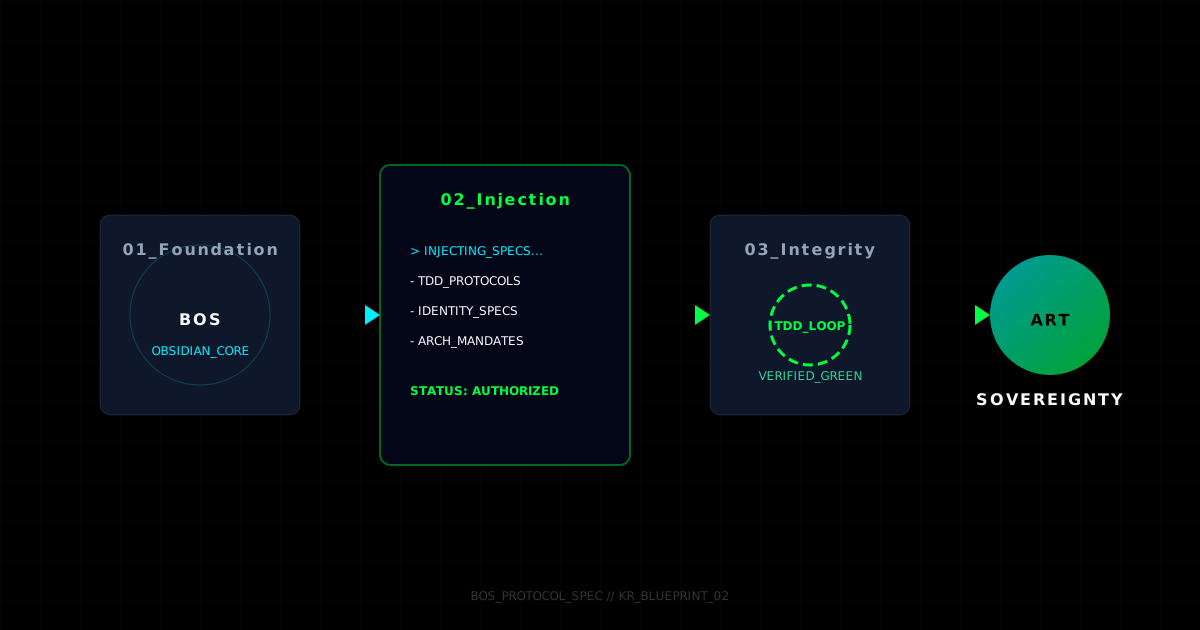
To solve this, we developed the BOS Protocol for AI-Assisted Engineering. It’s a shift from “Chatting with AI” to “Injecting Architecture.”
The protocol is built on four inmovable pillars:
- Intent over Intuition: We don’t ask the AI to “think.” We provide the thoughts. Our manual-driven context (Obsidian BOS) act as the blueprints. The human is the Architect; the AI is the Precision Craftsman.
- Spec-Driven Integrity: Every line of code must be born from a Specification. Documentation is not a byproduct; it is the source of truth. If the code deviates from the spec, the system fails.
- The Integrity Loop: High speed requires high-end brakes. Every AI-generated function must pass through a rigorous TDD (Test-Driven Development) cycle. Green tests are the only evidence we accept.
- Engineering as Art: We reject “machine-style” bloated code. If it’s not elegant, minimal, and legible, it’s not finished. The code is our signature.
The Craft: Injecting Context
In our laboratory, we don’t start with a blank chat window. We start by feeding the AI our Identity Specs, our Testing Guidelines, and our TDDs.
Instead of saying “Create a booking system,” our protocol dictates:
“Implement the service defined in TDD_Bookings_v2.md. Follow the Decoupling standards in ARCHITECTURE.md. Use the Matrix Neon design tokens for the UI. Validate against the living OpenAPI contract.”
This turns the AI into a force multiplier of our own criterion. We are not ceding our judgment; we are automating its execution.
The Result: Scalability through Sovereignty
By applying the BOS Protocol, we’ve achieved something that industrial-grade companies struggle with: The capacity of an entire engineering department with the precision of a single artisan.
We don’t fear the speed of AI because we own the cimientos (the foundations). We are not just writing code faster; we are building a more resilient future.
The “Vibe” is for amateurs. The Protocol is for those who build to last.
dammgo labs - Engineering Longevity.